In restaurant operations, many owners, managers, and even kitchen staff often hear the termSKU。
Some people think it only belongs to retail and has little to do with restaurants. Others have heard the term before but cannot clearly explain what it means.
In reality, SKU is a very common and important concept in restaurant management. It directly affects menu design, cost control, inventory planning, and operational efficiency.
This article explains in simple termswhat SKU means in a restaurant, why it matters, and why having too many SKUs can actually make a restaurant harder to run.
What Is an SKU?
SKU stands for Stock Keeping Unit. In simple terms, it can be understood as the smallest sellable unit.
In a restaurant setting, an SKU usually refers to:
Any item, size, or variation that can be ordered, priced, and prepared separately.
That means if a customer can select it as an individual option on the menu, it is usually a separate SKU.
A Simple Way to Understand It
Anything a customer can choose as a separate item on the menu is basically an SKU.
A Simple Restaurant SKU Example
Take Coca-Cola as an example. If a restaurant sells it in three sizes:
- Coca-Cola (Small)
- Coca-Cola (Medium)
- Coca-Cola (Large)
These may all be “Coke,” but because they have different sizes, prices, and inventory calculations, they are treated as three different SKUs.
The same logic applies to many restaurant situations:
- The same drink with different cup sizes is usually different SKUs
- The same combo sold for dine-in and delivery may be managed as separate SKUs
- Add-on versions, double portions, or kids’ versions may also become separate SKUs
So an SKU is not just a product name. It is a unit that can be managed, counted, sold, and analyzed separately.
Why Do Restaurants Need SKU Management?
Many restaurants do not become inefficient because of a lack of customers. They struggle because the menu is too complicated, the kitchen workflow is messy, and inventory is difficult to manage. Good SKU management helps simplify all of this.
1. Better Cost and Profit Tracking
Each SKU should be linked to a clear set of numbers, including:
- Ingredient cost
- Selling price
- Gross margin
- Waste or loss rate
When SKUs are clearly defined,restaurant owners can better understand which items are truly profitable and which items look popular but deliver low margins.。
Without proper SKU management, cost accounting often becomes confusing. As a result, a restaurant may generate decent sales but still end up with disappointing profits.
2. Easier Inventory Management and Less Waste
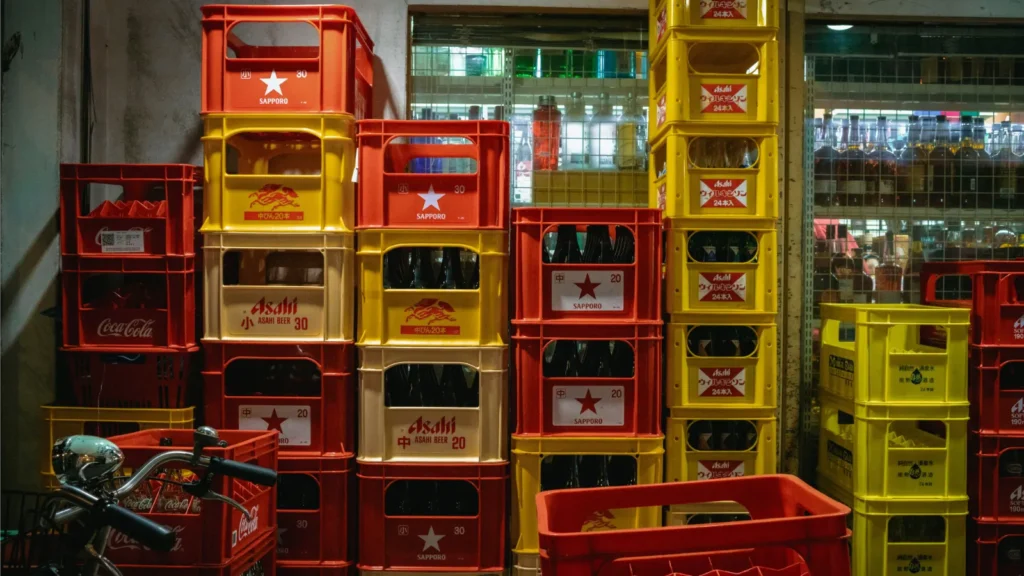
SKU management is closely connected to inventory management.
When you know how much each SKU sells, you can more accurately estimate ingredient consumption, purchasing needs, and stock turnover. You can also identify which products move quickly and which ingredients are more likely to be wasted.
For example, if medium-sized drinks sell much better than small or large sizes, the store can prepare cups, ingredients, and purchasing plans more efficiently instead of relying only on guesswork.
For restaurants, understanding SKUs often means understanding how inventory really moves.
3. Higher Efficiency and Fewer Mistakes
In general, the more SKUs a restaurant has, the more complicated operations become.
Too many SKUs can create several common problems:
- Menus become too long and harder for customers to navigate
- Front-of-house staff are more likely to make ordering mistakes
- Kitchen execution becomes harder to standardize
- Inventory preparation becomes more complicated
- Staff training takes more time
On the other hand, when SKU management is under control, operations usually run more smoothly:
- Menus are clearer
- Kitchen workflows are simpler
- Error rates are lower
- Inventory prep is easier
- Overall efficiency improves
For many restaurant owners,reducing unnecessary SKUs is itself a way to improve profitability.
Are More SKUs Always Better?
Not necessarily.
Many restaurant owners assume that offering more options will automatically satisfy more customers. But in reality, having too many SKUs does not always generate more sales. Instead, it can make the business much harder to manage.
This is especially true for small and mid-sized restaurants, bubble tea shops, and quick-service restaurants. When a menu includes too many similar, overlapping, or low-performing items, the result is often:
- More complicated purchasing
- Greater storage pressure
- Higher waste
- Slower kitchen operations
- Harder decision-making for customers
- Less focus on best-selling items
From an operations perspective, the goal is not to have as many SKUs as possible. The goal is to have SKUs that aresellable, manageable, profitable, and operationally efficient.。
A Simple Way for Restaurant Owners to Remember It
If you want to remember the idea in the simplest way, keep these two lines in mind:
- Fewer SKUs = simpler operations, easier management, and better cost control
- More SKUs = more complexity, harder management, and potentially higher waste
Of course, fewer SKUs does not mean your menu has to feel limited. It means reducing unnecessary complexity while still meeting customer demand.
A strong menu is not one that offers every possible variation.It is one that keeps the products that are easiest to sell, easiest to standardize, and most likely to generate profit.
Which Restaurants Should Pay More Attention to SKU Management?
In reality, almost every restaurant should care about SKU management, but these types of businesses especially need to pay attention:
Bubble Tea Shops and Coffee Shops
These stores often end up with too many SKUs because of cup sizes, sweetness levels, ice levels, toppings, and flavor combinations.
Fast Casual and Quick-Service Restaurants
Combos, side items, upgrades, and add-ons can quickly make the menu difficult to manage if SKUs are not properly organized.
Chinese Restaurants
Chinese restaurant menus are often already large and complex. Once different portion sizes, combo formats, and cooking styles are added, SKU management becomes even more important.
Multi-Location Restaurant Groups
Once there are multiple locations, inconsistent SKU structures can affect purchasing, staff training, inventory tracking, and performance reporting.
Final Thoughts
SKU may sound like a technical term, but the concept itself is simple.
For restaurants, an SKU is essentiallya specific product unit used for selling, pricing, inventory planning, and reporting.。
Once you understand that, many operational problems become easier to solve.
From menu design and inventory planning to cost tracking and kitchen efficiency, SKU management is a basic but highly important part of running a restaurant well.
If you are a restaurant owner, manager, or someone preparing to open a restaurant, it may be worth reviewing your menu and asking:
- Which SKUs are actually making money?
- Which SKUs are only making operations more complicated?
- Which SKUs can be merged, simplified, or removed?
In many cases, improving restaurant efficiency does not start with adding more. It starts with simplifying what you already have.