Home > U.S. Restaurant Maps > U.S. Subway Map
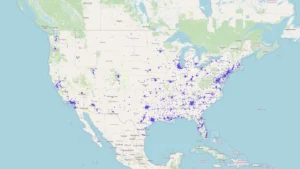
Latest U.S. Subway Location Map:
Subway Restaurant Count and Distribution in the U.S.
U.S. Subway Map (2026 Update)
*The data on this page is based on publicly visible restaurant location information from Google Maps in the United States as of May 2026.The dataset has been manually deduplicated and standardized for address formatting.
How Many Subway Restaurants Are There in the U.S.?
As of May 2026,there are 18,177 Subway restaurants in the U.S.
As one of the most recognizable fast-food chains in the country, Subway has long been known for its enormous store count, wide geographic reach, and deep penetration into both major metropolitan areas and smaller local markets. Unlike brands that rely more heavily on dense urban centers, Subway has built a network that extends far beyond large cities, reaching suburbs, small towns, transportation corridors, and everyday neighborhood retail areas across the country.
Based on this nationwide map, Subway remains one of the most broadly distributed and deeply embedded restaurant chains in the U.S.
How Is Subway Distributed Across the United States?
Looking at both the national map and the state-by-state data, Subway’s footprint shows a very distinct pattern:
Broad national coverage, stronger density in the Midwest and East, with major population states still serving as core anchors.
Unlike more regionally concentrated brands such as Chick-fil-A, Subway’s distribution is far more balanced across the country. Nearly every state has a meaningful number of locations.
At the same time,states such as California, Texas, Florida, Ohio, Illinois, New York, and Michigan stand out as especially important concentration zones, helping form a dense and continuous network across much of the central and eastern U.S.
Overall, Subway is not dependent on just a few core regions.It operates as a truly national high-coverage restaurant chain.。
The 5 States with the Most Subway Restaurants
- California (CA) — 1,780 locations, 9.79%
California has the largest number of Subway restaurants in the country. Its massive population, multiple large metro areas, and broad range of consumer markets make it a long-term anchor state for the brand.
- Texas (TX) — 1,721 locations, 9.47%
Texas trails California by only a small margin and serves as one of Subway’s most important core markets in the South and Southwest. Its wide urban corridors, suburban expansion, and highway-based commercial network are all well suited to Subway’s operating model. - Florida (FL) — 999 locations, 5.50%
With nearly 1,000 locations, Florida is Subway’s most important market in the Southeast. Population growth, tourism, and steady everyday demand support a large and resilient store base. - Ohio (OH) — 861 locations, 4.74%
Ohio ranks fourth nationwide, showing that Subway still maintains strong penetration in Midwestern states with large numbers of medium-sized cities and established suburban markets. - Illinois (IL) — 792 locations, 4.36%
Illinois, especially the Chicago metro area, remains one of Subway’s most important strategic hubs in the Midwest.
Together, these five states account for 33.86% of all Subway restaurants in the U.S., showing that while Subway has broad national coverage, the largest states still contribute a major share of total locations.
Distribution Highlights
1. Subway has exceptionally strong nationwide coverage
One of the clearest takeaways from the data is that Subway is not concentrated in just a handful of superstates. Instead, it has built a stable presence across nearly the entire country.
Even smaller states still maintain a meaningful Subway footprint. This wide reach is one of the defining characteristics of the brand.
2. The Midwest and East form a dense multi-state corridor
States such as Ohio, Illinois, New York, Michigan, North Carolina, Pennsylvania, and Virginia together form one of Subway’s most important density corridors in the U.S.
This suggests that Subway continues to hold a strong position in established population centers, legacy industrial states, suburban commuting regions, and densely connected urban belts.
3. California and Texas operate as dual national anchors
California has 1,780 locations, while Texas has 1,721. Together, the two states account for 3,501 Subway restaurants.。
That level of concentration highlights the brand’s ability to perform strongly in both the country’s largest West Coast state and its largest Southern state, showing broad adaptability across very different regional markets.
4. The Southeast remains a major support region beyond Florida
In addition to Florida, states such as Georgia, Tennessee, South Carolina, Alabama, Kentucky, and Louisiana all post meaningful Subway counts.
This indicates that Subway’s Southern footprint is not limited to one or two standout states. Instead, it has developed a broad and durable regional network across much of the South.
5. Smaller states and lower-population markets still show solid baseline coverage
A major part of Subway’s strength lies in its ability to penetrate smaller cities, local commercial corridors, and secondary markets.
Beyond major metro clusters, the map shows locations spread across smaller communities, interstate corridors, and regional service centers. This makes Subway look less like a city-focused chain and more like a foundational national restaurant network.
What Does the Subway Map Show?
When all 18,177 Subway locations are plotted on a single map, one conclusion becomes very clear:
Subway’s core strength lies not in a few breakout regions, but in broad national penetration across many types of markets.
It performs at scale in major states such as California, Texas, and Florida, while also maintaining strong presence across the Midwest, Northeast, and many lower-population states.
This ability to combine large-scale urban presence with deep secondary-market coverage is one of the main reasons Subway has remained one of the largest restaurant chains in the U.S.
Conclusion
Overall, as of May 2026, Subway’s 18,177 U.S. restaurants can be summarized in three key themes:
Dual large-state anchors, a dense Midwest–East corridor, and deep nationwide coverage.
Whether viewed through total store count, state-by-state reach, or regional penetration, Subway remains one of the most representative brands for understanding the structure of the U.S. fast-food industry.
If you want to explore the U.S. footprints of more restaurant brands, visit our Restaurant Data Center